

Donor Embryo Transfer in Mexico City and Metepec
Donor embryo treatment means transferring to the patient embryos formed with eggs and sperm from donors who were previously evaluated and selected, after her endometrium has been prepared. At CEMPI (Centro Especializado en la Mujer y la Pareja Infértil, our Center for Women and Infertile Couples) we offer it in Mexico City (Benito Juárez) and in Metepec (Toluca). Here we explain who it is for, how the process works step by step and how the cost is planned, so you arrive at your evaluation well informed.
Estimated duration
The endometrial preparation and embryo transfer cycle usually runs over 18 days.
Clinical area
Assessment by your treating physician and the procedure performed by embryologists and andrologists in our laboratory.
Where it is performed
Endometrial preparation is monitored in the consulting room using high-resolution ultrasound equipment. Embryo transfer takes place in an operating room used exclusively for fertility procedures, free of bacteria, fungi, parasites and airborne particles; it is an outpatient procedure of 10 to 15 minutes that generally does not require sedation.
Support
The medical team and PLANEA staff will provide comprehensive, close follow-up throughout your treatment. Our commitment is to guide you through clear, transparent and timely communication.
Donor embryo at a glance
- What it is: transfer of embryos formed with eggs and sperm from evaluated and selected donors.
- Who it is for: patients with combined ovarian and male factors, with an inheritable genetic condition, or after several unsuccessful fertility treatments.
- Duration: endometrial preparation and transfer usually take about 18 days.
- The transfer: outpatient, 10 to 15 minutes, ultrasound-guided and usually without sedation.
- Cost: it depends on the procedure and your case; PLANEA, CEMPI's financial planning team, gives you a written proposal.
- Where: Mexico City (Benito Juárez) and Metepec (Toluca).
- First step: an evaluation consultation with your treating doctor.
What is donor embryo treatment?
It is an assisted reproduction treatment that uses embryos already formed with eggs and sperm from donors. Those donors were evaluated and selected beforehand. The embryos are transferred to the recipient patient when her endometrium, the inner lining of the uterus where the embryo implants, is in suitable condition.
Unlike an IVF cycle with your own eggs, there is no ovarian stimulation or egg retrieval for the recipient. Treatment focuses on preparing the endometrium and on the transfer. The decision to use donated embryos is personal and medical, so it always starts with a consultation.
Where the embryos come from and how they are evaluated
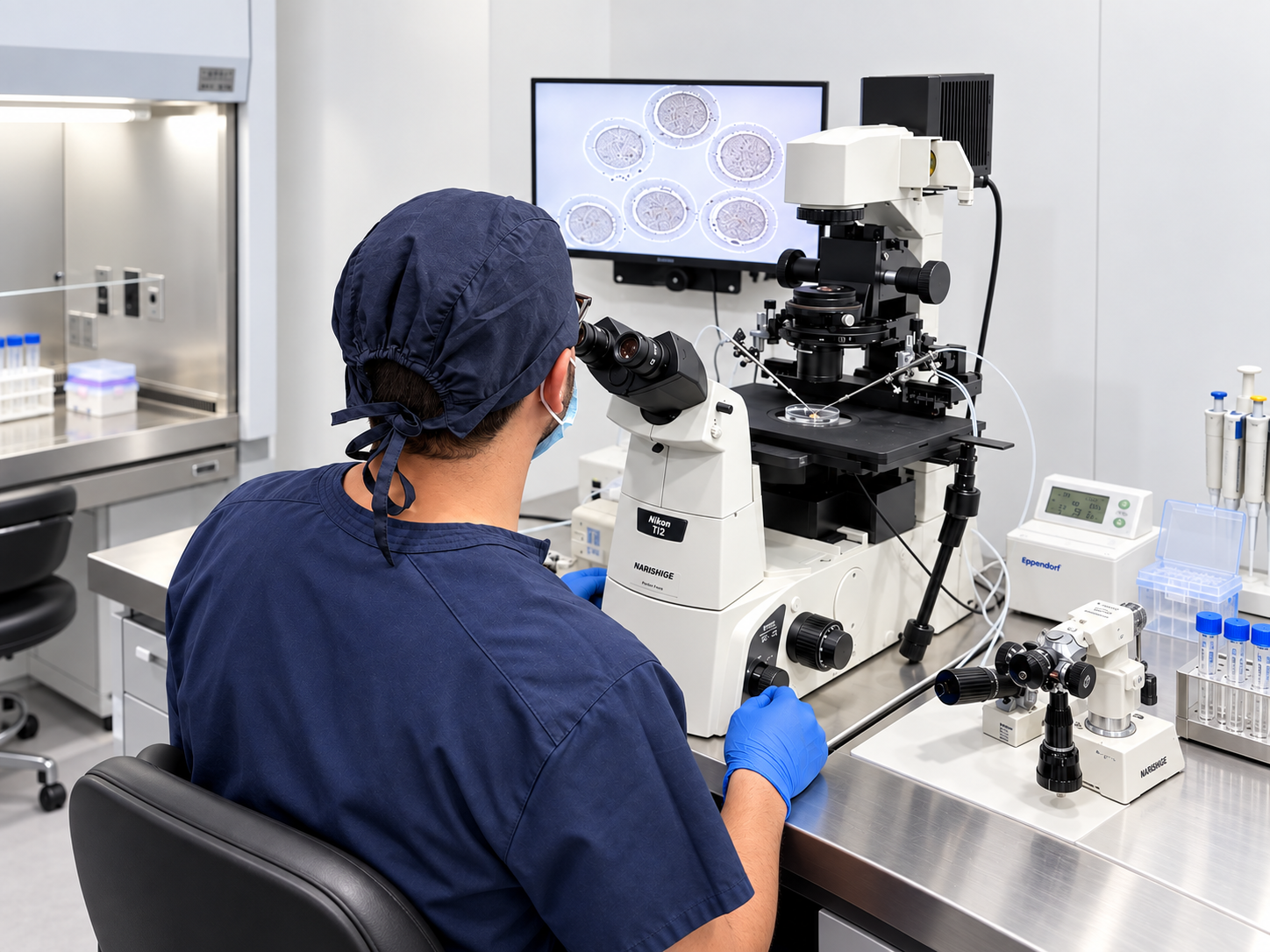
In the laboratory, the embryologists evaluate each embryo by its morphology and developmental characteristics and assign a grade based on established embryo quality criteria.
What this page does not offer
This page is informational. We do not publish donor information, we do not promise results and it does not replace your doctor's evaluation. Every plan is built from your diagnosis, not from a standard protocol.
Who is donor embryo treatment for?
It may be considered in several situations. Your doctor confirms this option after reviewing your tests and your partner's, if you have one, and only then proposes it.
Combined ovarian and male factors
When eggs and sperm both have limitations at the same time, options with your own gametes can be harder. In that case, donated embryos may be an alternative. Before suggesting them, your doctor checks whether other possibilities exist for you.
Inheritable genetic condition
If you or your partner carry a genetic condition that could be passed on, your doctor can explain the options available. Learn about preimplantation genetic testing as well.
Several unsuccessful fertility treatments
After several treatments that did not result in pregnancy, some people consider this option. Your doctor reviews what you have already tried and decides with you what comes next.
How we work, step by step
- 1.
Selection of the donated embryos
The laboratory evaluates their quality before the decision is made.
- 2.
Endometrial preparation
Your endometrium is prepared with the treatment your doctor indicates and monitored with high-resolution ultrasound in the consulting room. This stage and the transfer usually take about 18 days.
- 3.
Embryo transfer
When the endometrium is ready, the embryo is transferred. It is an outpatient procedure of 10 to 15 minutes, guided by ultrasound.
What endometrial preparation and the transfer are like
The endometrium needs the right thickness and characteristics for the embryo to implant. That is why preparation is monitored closely.
Ultrasound monitoring
Your doctor checks your endometrium with high-resolution ultrasound during preparation. With those images, they decide when the moment for the transfer has come.
Transfer day
It lasts 10 to 15 minutes, usually needs no sedation and is done under ultrasound guidance. Afterward you can go home the same day, with your doctor's instructions.
If the endometrium is not ready
The transfer is scheduled when the endometrium is in suitable condition. If it is not, the cycle can be postponed and the embryos stay vitrified (frozen) without being lost. Your doctor explains the next steps.
Laboratory and embryo evaluation
In the laboratory, the embryologists and andrologists evaluate embryos by their morphology and developmental characteristics and assign a grade based on established embryo quality criteria. The transfer is done under ultrasound guidance to place the embryo in the right spot. To learn how the laboratory works in IVF, read in vitro fertilization.
Legal and ethical aspects to know
Your doctor explains which documents and consents are signed before treatment. If you have questions about rights and responsibilities, we also recommend consulting a specialist lawyer. It is an important decision, and you can take the time you need.
How to prepare for your evaluation
Arriving with organised information makes the first consultation more useful. You do not need to have all the answers; your doctor accompanies you in every decision.
What to bring
Bring your tests and reports from earlier treatments, including previous IVF cycles if you had them. If you have a partner, it helps if they attend if you both wish. See the full list on first visit.
Questions you can ask
Ask which tests you need before starting, whether this option is right for your case, how long the process would take and what the financial proposal includes. You can also ask which consents you must sign and what happens to the embryos if the cycle is postponed. Your doctor answers based on your case.
Other options you can learn about
If your doctor considers it, you can also review egg donation or donor sperm.
Cost and financial planning
The cost of donor embryo treatment depends on the indicated procedure and on your particular case, so there is no single price. PLANEA, the CEMPI team that organises treatment costs, prepares a written proposal with the included services, and a financial advisor explains the payment options.
Payment options
You can review financing over 2, 4, 6 and 9 months, subject to evaluation and approval, and pay with bank credit cards. See costs and promotions and financial planning.
Where we see patients
Mexico City, Benito Juárez
Monday to Friday 8:00 a.m. to 4:30 p.m. and Saturday 8:00 a.m. to 2:00 p.m. See the Mexico City location page.
Metepec (Toluca), State of Mexico
Monday to Saturday 10:00 a.m. to 2:00 p.m., by appointment. See the Metepec location page.
If you live in another city
Part of the follow-up can be coordinated remotely. Learn about follow-up for out-of-town patients.
Medical team
Dra. Eva Bonifacio León, medical director of CEMPI. Gynecology and Obstetrics, Human Reproductive Biology.
Frequently asked questions about donor embryo
With an evaluation consultation. The treating doctor reviews your history, tests and goals, and decides with you whether donor embryo is the right option.
Related services
Egg donation, in vitro fertilization (IVF) and preimplantation genetic testing (PGT).

Book your evaluation
Talk to a CEMPI specialist and resolve your questions about donor embryo treatment. You will receive an individual plan and a clear proposal.